Reducing inoculum – Lab trials

Lab trials - reducing inoculum

To reduce disease inoculum levels, researchers have investigated the practice of using high rates of urea on the soil surface immediately surrounding infected plants.

Lab trials at South Johnstone used a soil bioassay with spores of Fusarium oxysporum f.sp. cubense (Foc), the fungus that causes Panama disease race 1. This was used as surrogate for tropical race 4. The inoculated soil was treated with one of the following treatments:
  • ‘control’ – no urea or lime treatment
  • urea (rate equal to 0.5 kg/m2)
  • lime (rate equal to 0.5 kg/m2)
  • both lime and urea (rate equal to 0.5 kg/m2).

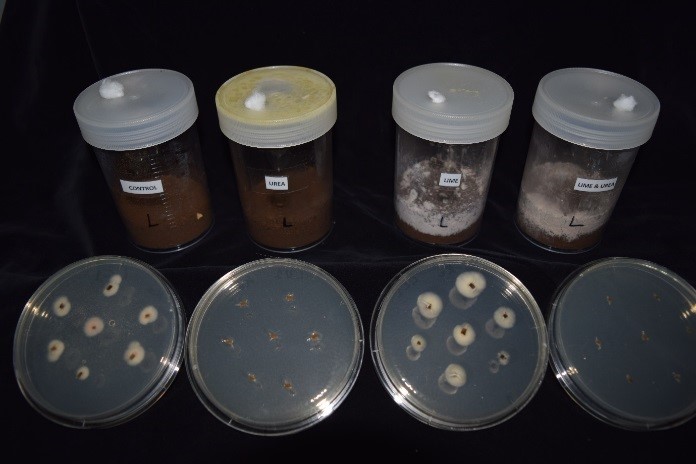
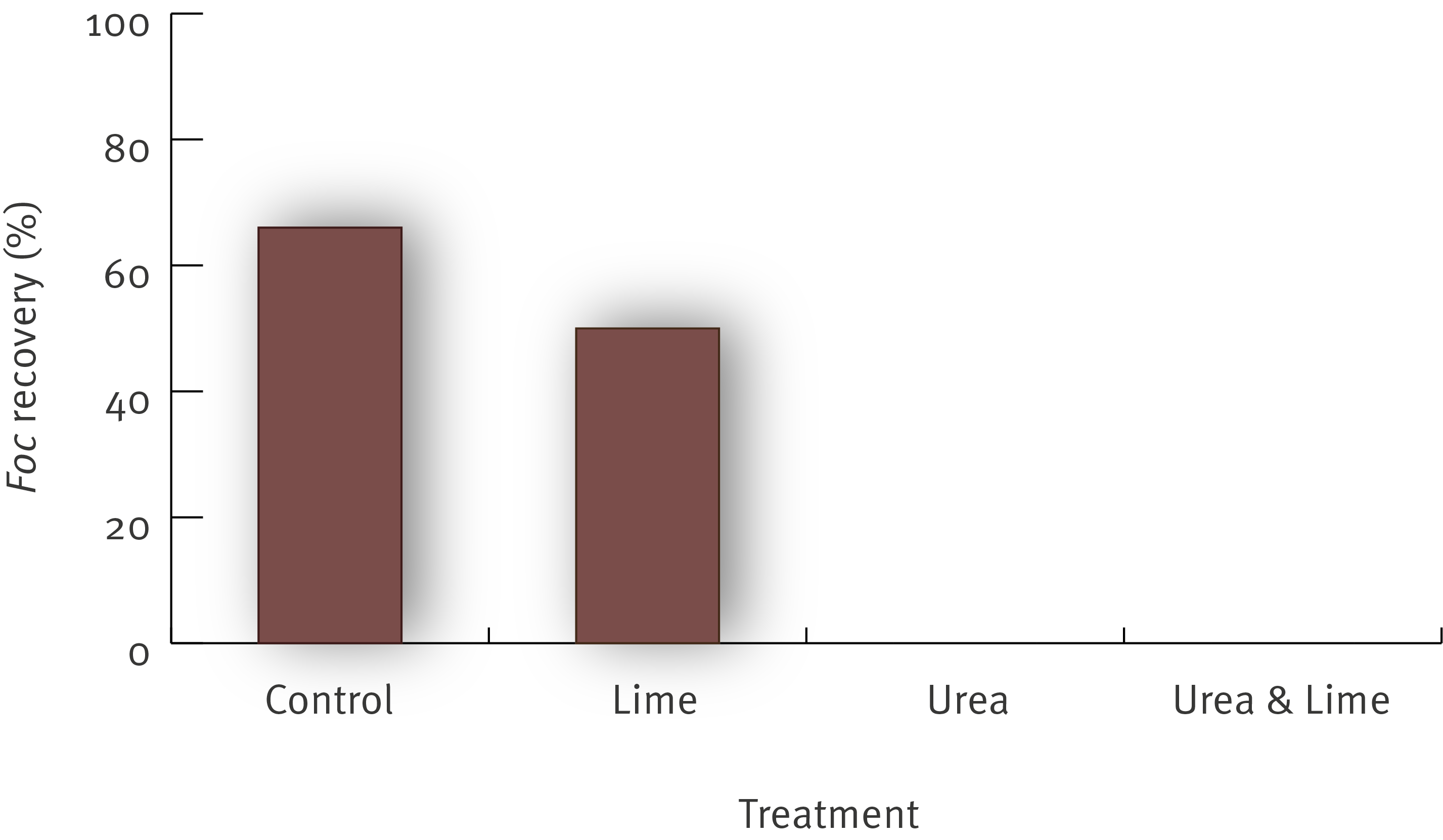
Interestingly, Foc was not recovered from soil that was treated with urea and the urea/lime combination. Foc was however recovered from soil treated with lime only, proving the application of lime on its own as ineffective at reducing inoculum levels.

Back: Jars of inoculated soil with different treatments. Front: Samples showing fungal development of control (far left) and lime (third from left) treatment.
Results of lab trials showing recovery of Foc from control and lime treatments, while no recovery of Foc was observed for the urea and urea and lime treatments.

Outcomes...

Lab trial results have shown that both urea and the combination of urea and lime at the specified rates are effective at killing the spores that cause Panama disease race 1.

Further lab investigations

Further trial work has evaluated the effectiveness of lower application rates of urea as well as chemical alternatives that are suggested to be toxic to Foc. The same bioassay using soil in jars was used to determine the effectiveness of the following treatments:
  • potassium chlorate @ 4, 8 and 16% (w/v)
  • sodium nitrite at 200, 400 and 800 ppm
  • nitrite at 200 and 400 ppm
  • lower rates of urea (rate equal to 0.031, 0.062, 0.125, 0.25 and 0.5 kg/m2). 

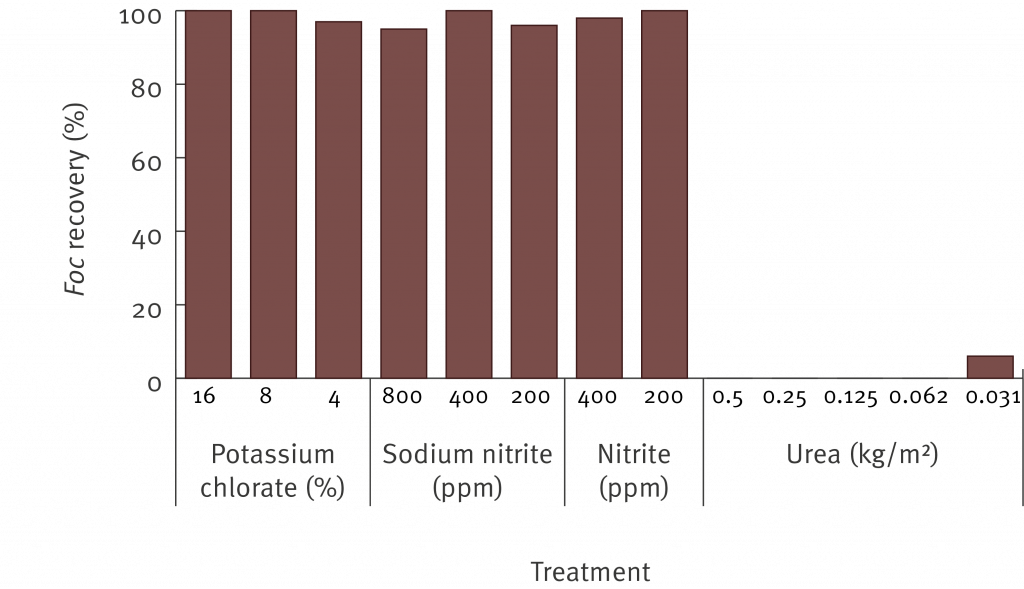
These investigations showed that urea applied at 0.062 kg/m2 or greater prevented Foc recovery from soil. All the other chemical alternatives were not effective at reducing the recovery rate of Foc

Results of lab trials showing urea applied at greater than 0.062 kg/m2 was the only effective treatment in preventing Foc recovery from soil.

Additional trials have investigated the effectiveness of different urea rates (between 0.031 and 0.062 kg/m2) and further explored alternative sources of ammonium. This time the effect of urea, ammonium nitrate + potassium hydroxide and aqueous ammonia were assessed. The trial showed that ammonia (NH3) from any source that produces a concentration equal to or above 2500 ppm was effective at preventing Foc from being recovered from the soil.

So what does this all mean?

These lab trials show the current methods for dealing with infected plants using urea (1 kg per square metre) would significantly help in reducing the amount of inoculum in infested banana paddocks. The trials further show that ammonia, rather than other gasses produced during the breakdown of urea, is likely to be responsible for the toxic effect on the fungus.

For more information about this work contact our better bananas team on 13 25 23 or email: betterbananas@daf.qld.gov.au

This trial was funded as part the Fusarium Wilt Tropical Race 4 – Biosecurity and Sustainable Practices (BA14013) project, which was funded by Hort Innovation, using the banana research and development levy, co-investment from the Queensland Department of Agriculture and Fisheries and contributions from the Australian Government. Hort Innovation is the grower-owned, not-for-profit research and development corporation for Australian horticulture.

Reducing inoculum from plants infected with Panama disease

Reducing inoculum from plants infected with Panama disease

A key aspect of managing Panama disease tropical race 4 on an infested property, is the implementation of practices to reduce the amount of inoculum (number of spores) entering the soil. The management of infected plants via a careful and thorough destruction protocol is one of the most crucial of these practices. 

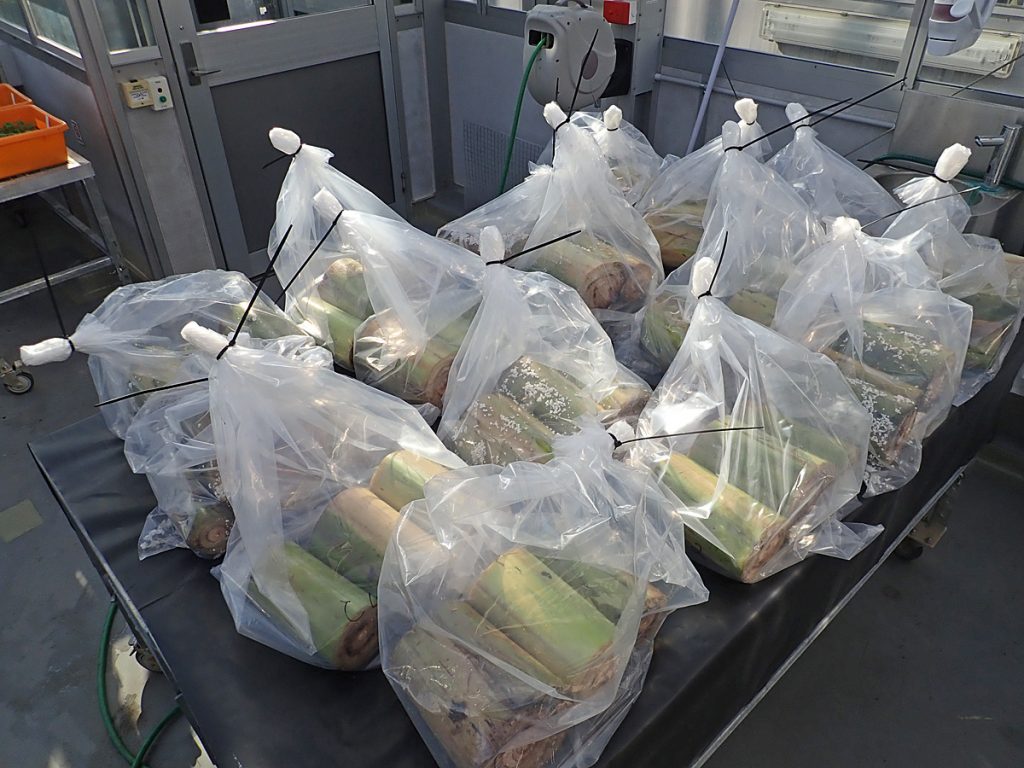
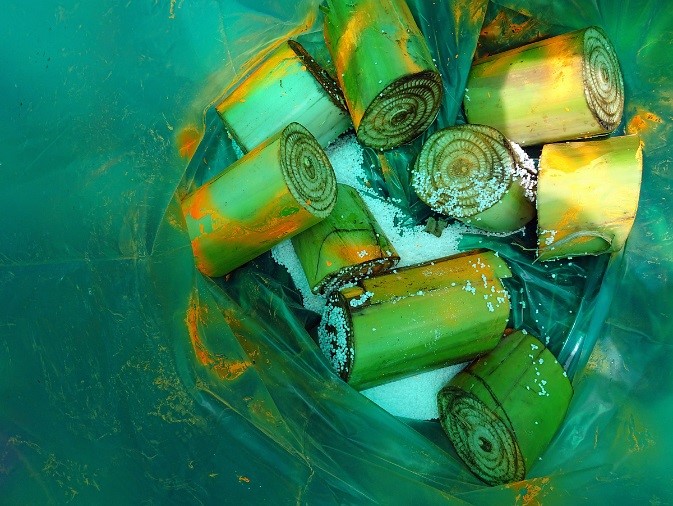
The current method requires infected plants to be cut up and placed into large plastic bags with 1 kg of urea to accelerate the breakdown of the fungus and plant tissue. Urea is then evenly applied to the soil surface at a rate of 1 kg per square metre around the infected stools, and 200 g of urea is also applied to each gouged corm. The entire treated area is then covered with heavy plastic to prevent runoff and to contain the breakdown gasses which help kill the fungus. 

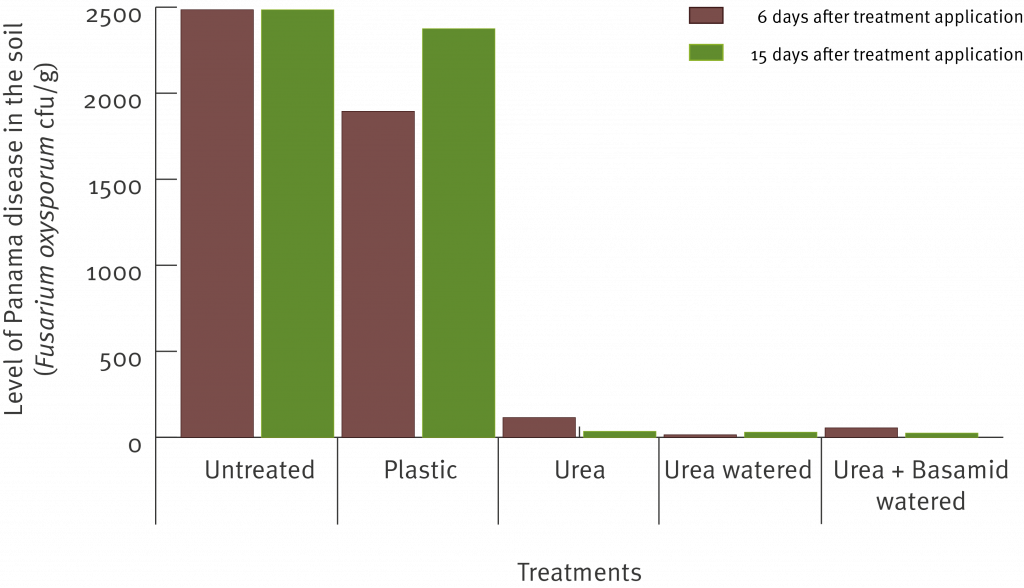
Lab and field trials conducted to validate this method, have showed the application of urea at this rate can significantly reduce inoculum levels. 

See below for details of the lab and field trials:

Due to strict biosecurity conditions this research has been conducted using Panama disease race 1 as a surrogate for Panama disease tropical race 4.

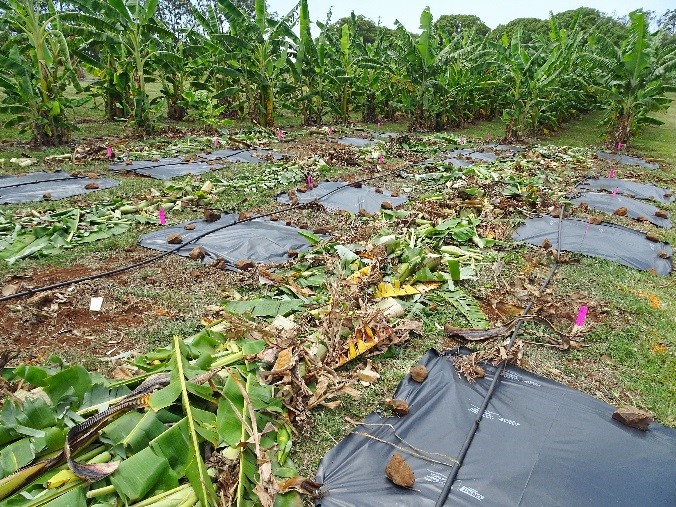
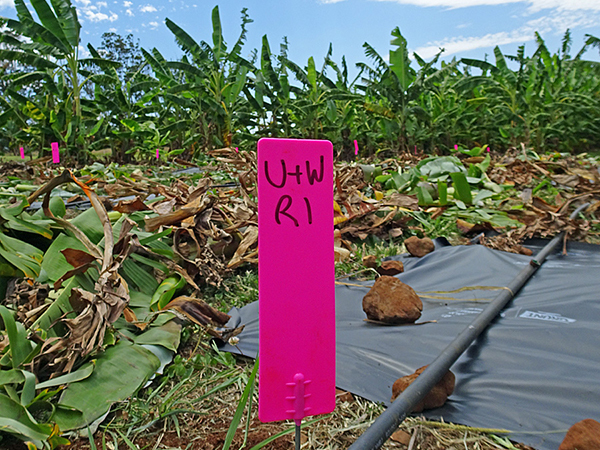
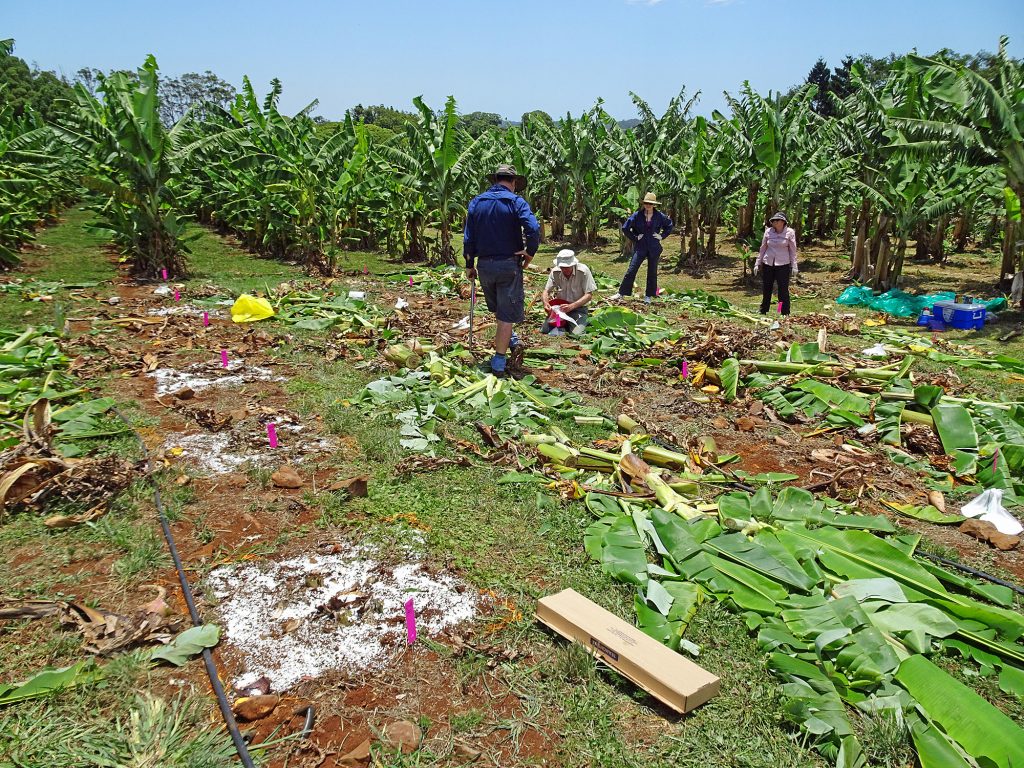
Black plastic in field trial, used to prevent runoff and contain breakdown gasses (Duranbah, New South Wales).
Urea application to ground around infected plants and to gouged corm (Duranbah, New South Wales).

Please note...

Due to the extremely high rates of urea used for this technique, the strategy is ONLY utilised to treat confirmed detections of Panama disease on properties where a Notice of presence of Panama disease tropical race 4 is in effect.

Best management practices

Two complementary guidelines for best management practices (BMP) are now available to the Australian banana industry. These BMPs provide national guidelines to encourage continuous improvement and adoption of best practice in the banana industry. Both BMPs consist of a self-assessment checklist and corresponding information resources. 

Best management practices: Environmental guidelines

This guide reflects the structure of the Freshcare Environmental code of practice, while providing specific banana industry content and best practice. The voluntary guideline provides a single point of reference for information relevant to environmental practices. Some of the practices have benefits that go beyond environmental interests and are practices that could potentially improve productivity and profitability.

The online system for this BMP allows you to electronically select the environmental practices that you have in place which will then:

  • automatically generate a management plan (which can be used for some environmental auditing systems). 
  • allow you to action this management plan (e.g. assign budget and responsibilities to improve practices).
  • allow you to anonymously compare your practices to moving industry benchmarks.

Login or download...

Did you know...

The banana industry’s ‘Better Bunch’  app is a time-saving device to assist growers to record their everyday farm practices to complement their BMP. If you complete your BMP on-line, you are currently able to access the app for free. 

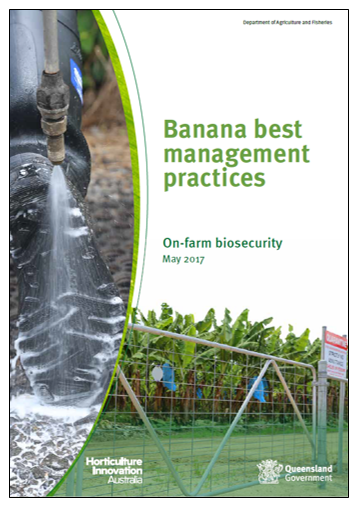
Best management practices: On-farm biosecurity

The Australian banana industry is vulnerable to pests and diseases. This best management practice (BMP) guideline can help growers implement effective on-farm biosecurity practices. It was developed following the detection of Panama disease tropical race 4 in Far North Queensland in 2015. It includes examples of on-farm biosecurity practices that are not only relevant to Panama disease but also minimises the risk of introducing other new pests, diseases and weeds onto your property. 

The online system for this BMP allows you to electronically select the biosecurity practices that you have in place which will then:

  • automatically generate a management plan
  • allow you to action this management plan (e.g. assign budget and responsibilities to improve practices).
  • allow you to anonymously compare your practices to moving industry benchmarks.

Login or download…

For more information on these BMP guidelines contact the better bananas team – betterbananas@daf.qld.gov.au or 13 25 23. 
BMP: Environmental guidelines – The project was funded as part of Reefocus Extension, a Queensland Government Reef Plan initiative, working with growers to increase farm productivity and profitability and improve water quality in the Great Barrier Reef. This project was funded as part of the Developing a best management practices guideline for the Australian banana industry project (BA11006). This project was funded by Hort Innovation using the banana research and development levy, co-investment from the Queensland Department of Agriculture and Fisheries and contributions from the Australian Government. 
BMP: On-farm biosecurity –This resource was developed as part of the Fusarium Wilt Tropical Race 4 – Biosecurity and Sustainable Solutions project (BA14013). This project was funded by Hort Innovation, using the banana research and development levy, with co-investment from the Queensland Department of Agriculture and Fisheries and funds from the Australian Government.
Hort Innovation is the grower-owned, not-for-profit research and development corporation for Australian horticulture.

Dans test with new post template

Recognition of Agrobaterium by the plant

“To initiate the tumorous state, cells of Agrobacterium must first attach to a wound site on the plant. Molecular evidence suggests that the recognition of Agrobacterium by plant tissue involves complementary receptor molecules on the surfaces of the bacterial and plant cells. It is though that the plant receptor molecule is a type of  pectin and that the bacterial receptor is a type of plysaccaride containing Beta-glucans.”

(Brock and Maddigan 1991)