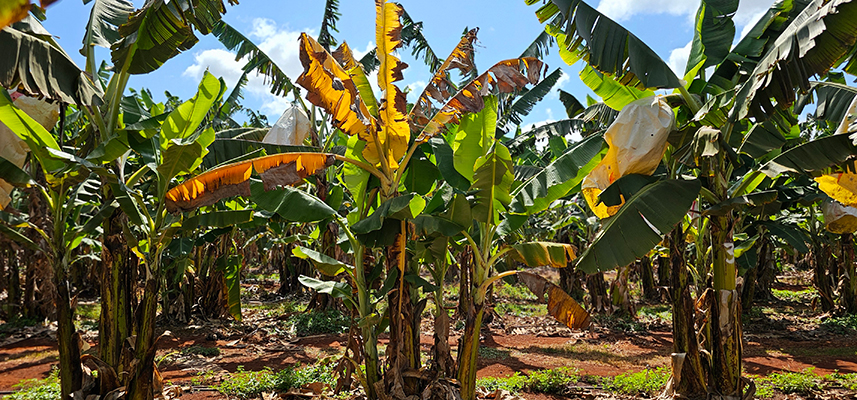



(Trial established 2023)
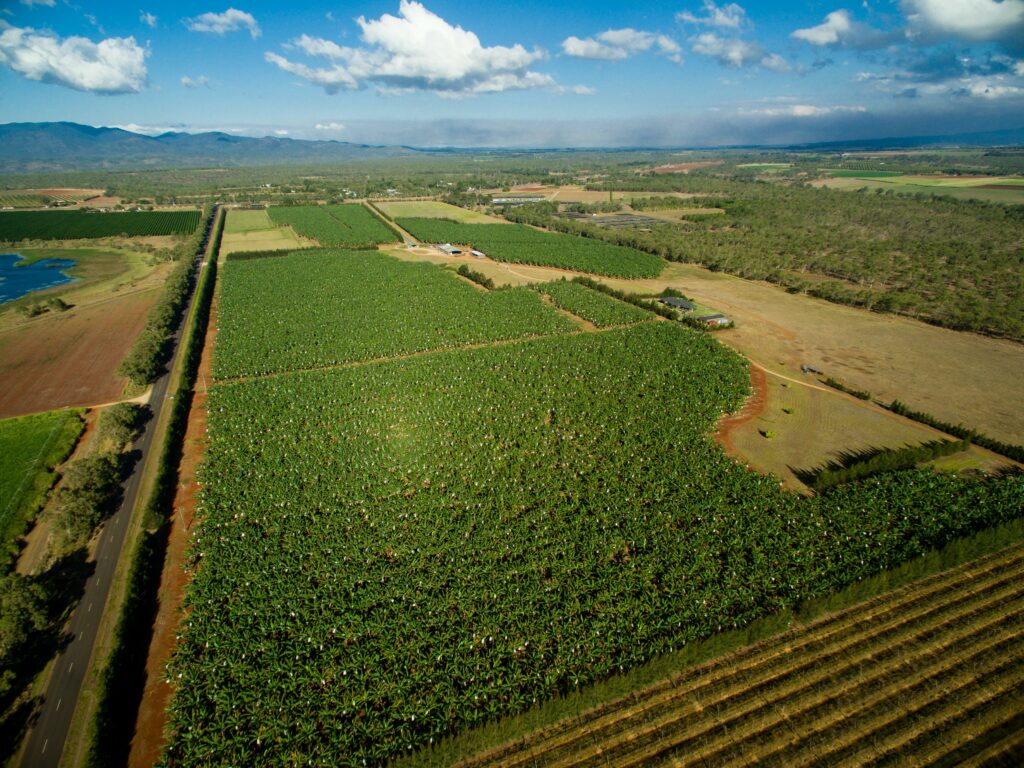
At two trial sites located near Mareeba researchers have assessed eight Lady Finger-like banana varieties for their resistance to Fusarium wilt Race 1 (Foc R1), comparing them against four reference varieties across both the plant crop and first ratoon cycle. The new varieties assessed were two Silk hybrids (Princesa and Tropical), one Lady Finger hybrid (Pacovan Ken) and a semi-dwarf Lady Finger (SCS451 ‘Catarina’), all from Brazil, plus the four best tasting Goldfinger selections from Queensland Department of Primary Industries (DPI)’s mutagenesis program (GMS 144, GMS 521, GMS 544 and GMS 903). Previous articles about the varieties were published in Australian Bananas August 2021 pp 18-19 and December 2025 pp 20-21, and the background to these Race 1 trials in April 2024 pp 26-27, which should be referred to for further information.
Initial plant crop findings were presented to industry delegates at last year’s 2025 Australian Banana Industry Congress. To recap, only three of the new varieties had Fusarium wilt symptoms at that time. They were SCS451 with 58% of plants affected, Tropical with 20% and Pacovan Ken with 5%. Of the reference varieties, 100% of Dwarf Ducasse plants were affected and 70% of Lady Finger.
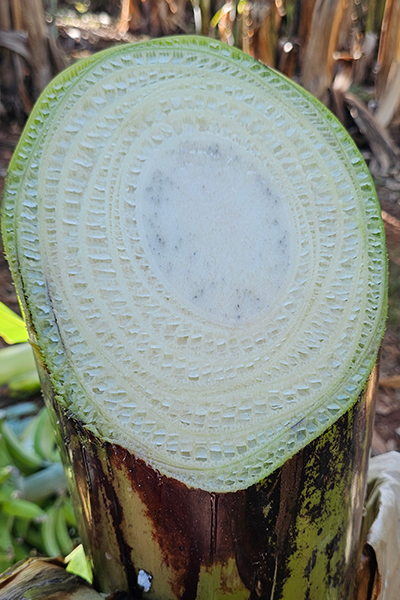
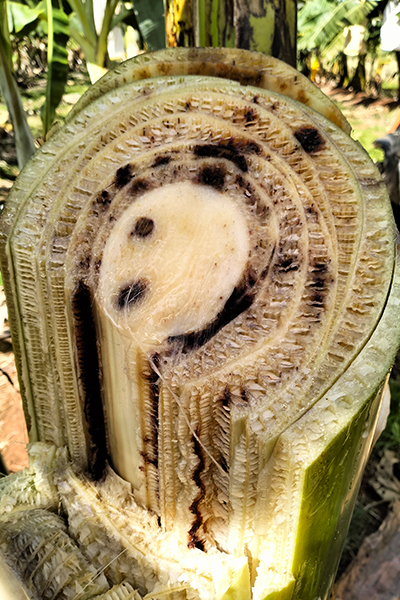
In addition to the disease incidence noted above, the internal disease symptoms were assessed at harvest by examining pseudostem vascular discoloration. Severity was rated using a 0–3 scale: 0 = No disease (Figure 1); 1 = less than 30% of leaf sheaths infected; 2 = 31–65% infection and 3 = greater than 66% infection (Figure 2).
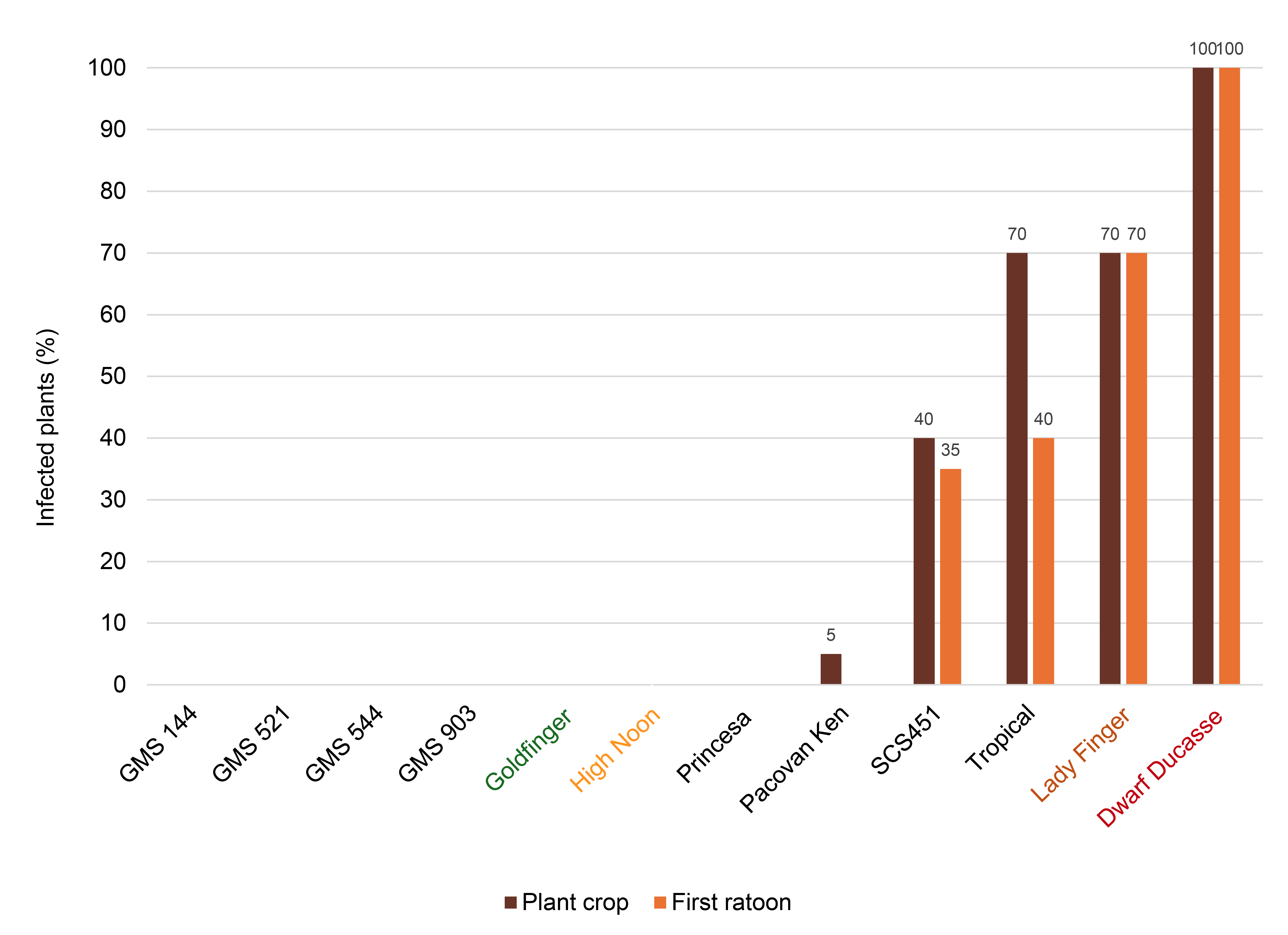
By March 2026, all first ratoon plants at both trial sites had reached harvest and disease assessments were completed. The results of disease incidence (Figure 3) is an average across both trial sites (20 plants in total of each variety) in the plant crop and first ratoon cycle. These results provide valuable insight into the field performance of the Lady Finger-like bananas grown under Atherton Tableland conditions.
Several varieties emerged as clear standouts throughout the trial. These included the four Goldfinger selections which had no disease symptoms, neither external nor internal, across both crop cycles. The mutagenesis approach used by DPI for crop improvement has not degraded the Fusarium wilt resistance of the Goldfinger parent while improving its’ eating quality which is very encouraging. Princesa was also without disease for the two crop cycles. It has good tasting fruit, which combines sweetness and a pleasantly distinctive flavour (more resembling its Silk/Sugar parentage). So, together with its disease resistance, this makes it a suitable candidate for further industry evaluation. These findings are encouraging for ongoing breeding and selection programs aimed at delivering improved Lady Finger-like bananas with disease resistance and acceptable commercial characteristics for Australian growers (Figure 4).
The semi-dwarf SCS451which tastes like Lady Finger, if not better, was imported to Australia because of its purported resistance to Fusarium wilt Race 1 in Brazil. In these trials it has exhibited slightly less symptoms of R1 disease than the industry standard, Lady Finger. The proportion of diseased plants across both the plant crop and first ratoon cycles ranged between 35-40% compared to Lady Finger which averaged 70% in both crop cycles. The performance was not as good as was hoped for, but perhaps the prospects for SCS451 may improve if combined with appropriate fallows and other crop management strategies which minimise disease severity.
Pacovan Ken was disease-free except for one plant, however, it does not have market prospects because of its inferior taste compared to Lady Finger.
These are included to provide a range of known levels of disease reaction and are key to the correct interpretation of results. It is not so much the absolute level of severity of disease present in the new varieties but how their level of disease severity compares with that of the reference varieties. We have included Dwarf Ducasse (very susceptible), Lady Finger (susceptible), High Noon (intermediate) and Goldfinger (resistant).”
The best tasting varieties of those identified with Race 1 resistance are in pre-commercialisation trials in north Queensland and New South Wales. Pre-commercialisation trials help obtain grower opinions and perspectives of the performance of new varieties under commercial production conditions (see April 2026 Australian Bananas pp 24-25 for more information). In our trials these varieties have demonstrated resistance to Fusarium wilt Race 1 on the Atherton Tablelands, but the colder winters experienced in NSW may compromise some of this resistance. Additionally, subtropical Race 4 (SR4) is present in some parts of the NSW industry and the resistance of the varieties to SR4 has not been determined. So, growers evaluating the varieties need to be aware of these possible limitations. The better tasting Goldfinger selections are now being screened for resistance to tropical Race 4 (TR4) in the Northern Territory.