By Ingrid Jenkins on behalf of the DPI Banana Extension Team
Safeguarding a family legacy
On the picturesque mid-north coast of New South Wales, third-generation banana farmer Michael Singh is taking proactive steps to safeguard his family’s 30-acre farm near Woolgoolga. With devastating diseases like Fusarium wilt already impacting and continuing to threaten banana-growing regions, Michael has embraced biosecurity as a key focus of his farming practices. Determined to protect his livelihood and secure a future for the next generation, Michael’s journey highlights the importance of planning, collaboration and taking action.
The threat of Fusarium wilt
Michael and his family currently grow Dwarf Rossi and Ducasse banana varieties. Both are highly susceptible to Fusarium wilt race 1 and subtropical race 4, which continue to spread across New South Wales banana-growing regions, significantly impacting growers.
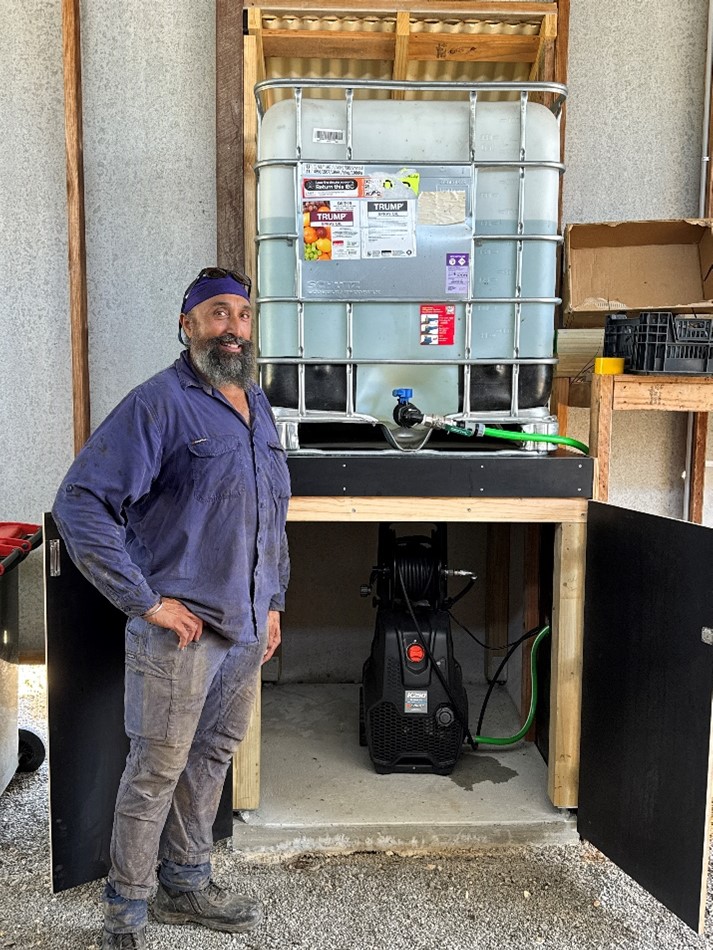
Michael Singh demonstrates his high-pressure disinfecting system.
There is also the ever-present risk of the introduction of the virulent strain, Fusarium wilt tropical race 4, which is not currently in NSW. Biosecurity is a big focus for Michael, who said: ‘As a third-generation banana farmer, with my son now stepping in as the fourth, we have a long history of growing bananas. I want to ensure that we can continue to grow bananas in years to come. That’s why I couldn’t just sit on my hands and hope we didn’t get Panama disease. Investing in biosecurity is about protecting everything we’ve worked for and securing a future for my son and the business.’
Building stronger biosecurity practices
Over the past 12 months, Michael has significantly enhanced his biosecurity measures, building on his existing practices such as exclusion zoning – limiting non-essential entry into his farm, boot exchange with dedicated farm boots, entry footbath, signage, and a secure front gate.
Michael is also proactive in having conversations with delivery drivers and service providers about his biosecurity procedures, ensuring that they use the dedicated footbath, disinfect their floor mats and providing an overview of what’s required of them. ‘Once they get the idea it’s OK. However, people can become complacent, so you need to keep on top of who is visiting and make sure they are doing the right thing,’ Michael said.
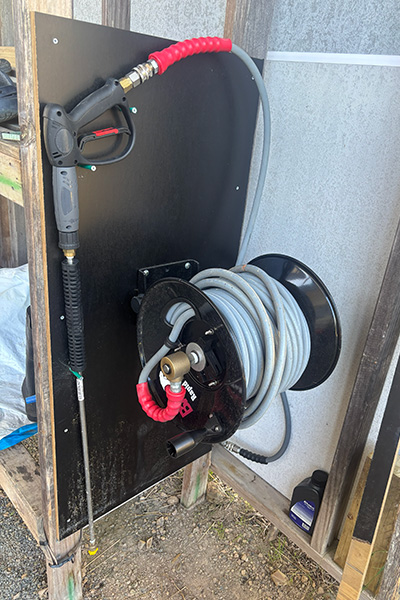
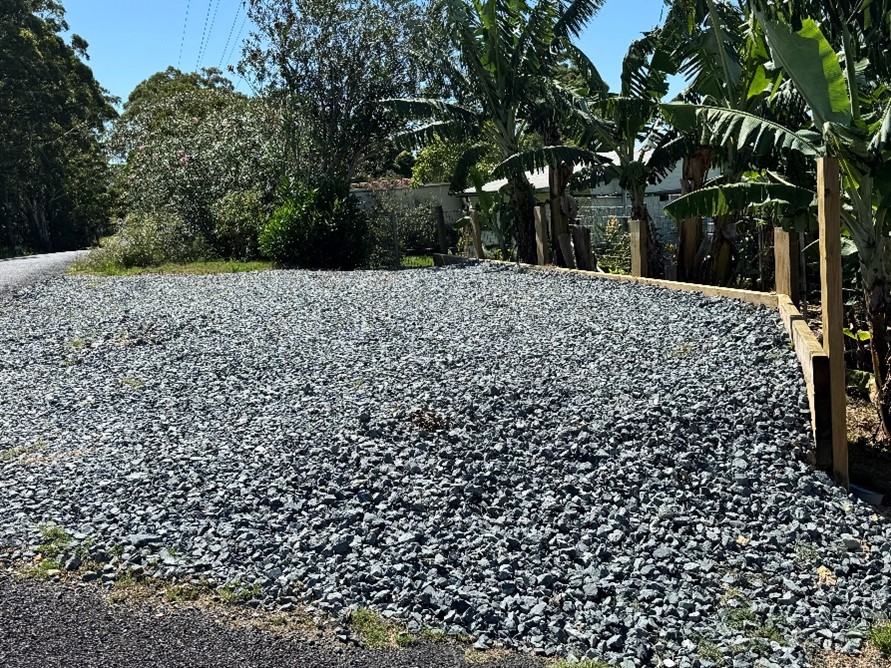
Among his new initiatives, Michael has constructed a perimeter fence along the boundary of a neighbouring banana farm to prevent the crossover of vehicles, machinery, and people. Additionally, he has developed a gravel carpark area that doubles as a space for vehicle cleaning and disinfecting for equipment, vehicles and vehicle floor mats. To support this, Michael installed a high-pressure cleaning system, which includes a slab and purpose-built cabinet to house a high-pressure washer. Above the washer sits a 1000-litre shuttle containing the disinfectant solution, which uses gravity to prime the system—eliminating the need for a separate pump.
Positioned above a high-pressure washer is a 1000-litre shuttle containing disinfectant solution, which is gravity-fed to prime the system.
The system delivers a high-pressure disinfecting solution through a long hose, providing sufficient reach to the wash-down and disinfecting pad.
New gravel exclusion car park/wash-down and disinfecting pad at entrance to farm.
Other simple biosecurity measures Michael has implemented
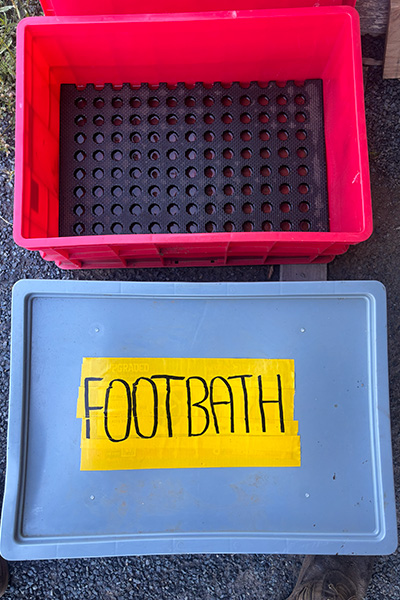
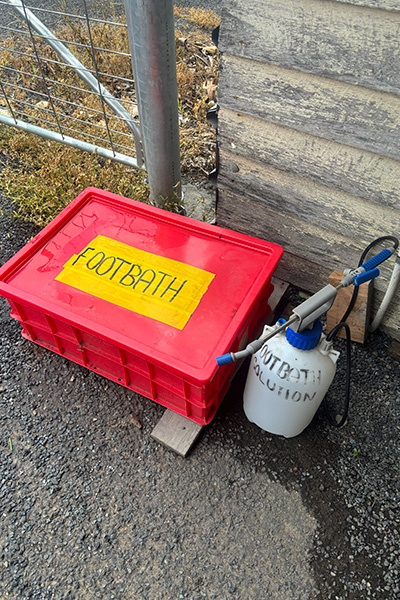
Footbath at front entry of property containing disinfectant solution and rubber mat to prevent slipping.
A footbath and pressure sprayer with disinfectant solution are located at the front entry of the property.
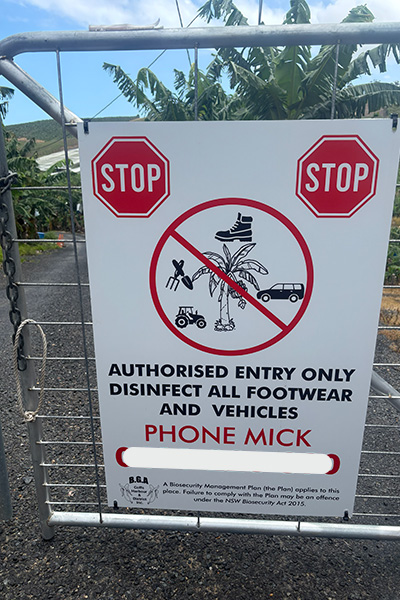
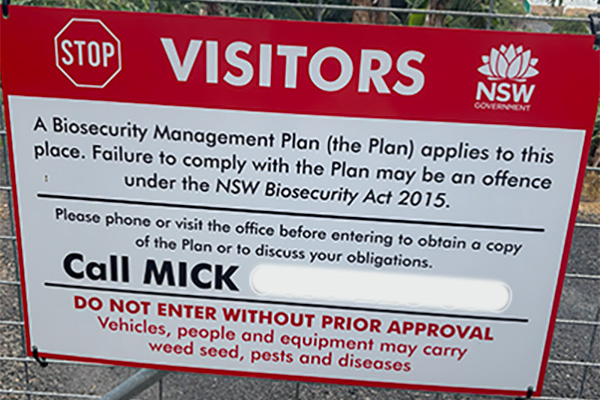
Clear signage displayed on the locked front entry gate.
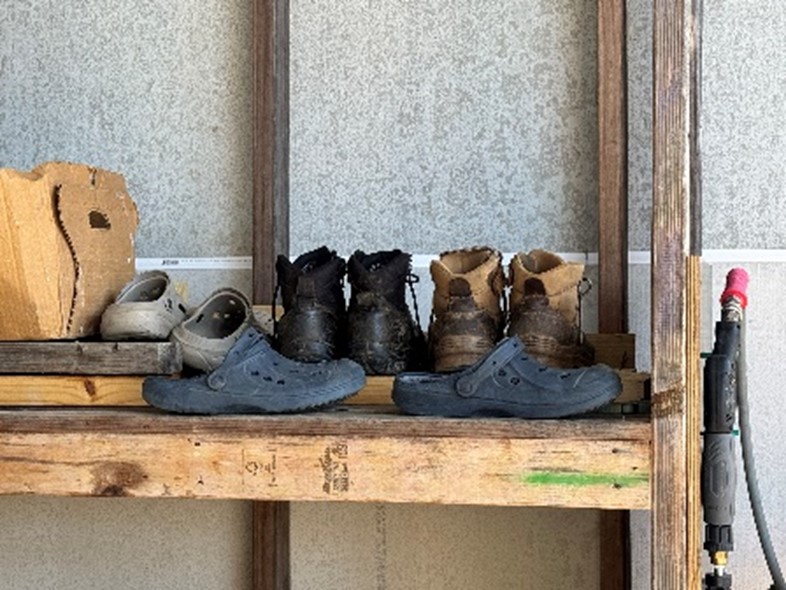
Boot exchange at entry of property. Staff leave external shoes at entry and change into shoes dedicated to the farm.
Clear signage with name and up-to-date contact number.
Conversations that led to action
Michael had been considering implementing these new initiatives to strengthen his biosecurity for some time. He sought advice and exchanged ideas with several key biosecurity experts, including ABGC’s R&D Manager Rosie Godwin, Tegan Cavallaro and Stewart Lindsay from Queensland’s Department of Primary Industries (DPI), and Steven Norman from New South Wales Department of Primary Industries and Regional Development (DPIRD). However, as Michael noted, having the knowledge and engaging in regular discussions about biosecurity doesn’t always lead to action.
A key moment came for Michael late last year when Far North Queensland banana farmer and ABGC board member Andrew Serra visited his farm. Over dinner that evening, a grower-to-grower conversation with Andrew became the turning point that inspired Michael to finally put his long-considered plans for a wash-down area and disinfecting system into action. ‘Timing is everything. I was out installing a fence when Andrew visited, and we started talking about biosecurity. Andrew was able to offer advice specific to my farm and business. Every farm is different, with its own unique layout, topography, size of business and Andrew understood that what worked for him wouldn’t necessarily work for me. Instead, he helped me think through what would be the best approach for my situation. Having those earlier conversations with key experts was invaluable, and when I spoke with another grower like Andrew, it all came together, and we were able to figure out the right solution,’ Michael said.
Michael has kept his biosecurity measures as simple as possible and is confident that they are well-suited to his farm’s specific needs. While he acknowledges that some factors affecting his farm are beyond his control, he is confident that he is doing everything possible to manage the aspects within his control.
Paying it forward
When asked how he would ‘pay it forward’ and share the advice he received with other growers thinking about biosecurity, Michael said: ‘Take the first step and make a change – don’t put it in the too-hard basket. Start having conversations. There are industry experts and fellow growers who are more than willing to share their experiences and knowledge to help.’
Get in touch
If you’d like to discuss biosecurity on your farm or need assistance connecting with other growers, please contact the DPI Banana Extension Team on 13 25 23 or email betterbananas@dpi.qld.gov.au.
Acknowledgements
A heartfelt thank you to Michael Singh for generously sharing his story and taking the time to contribute to this article.
Funding acknowledgement
This story has been written as part of the National Banana Development and Extension Program (BA25001). This program is funded by Hort Innovation, using the banana industry research and development levies, co-investment from the Department of Primary Industries and contributions from the Australian Government.
Hort Innovation is the grower-owned, not-for-profit research and development corporation for Australian horticulture.